
The vulnerabilities that match your versions, not your vendor
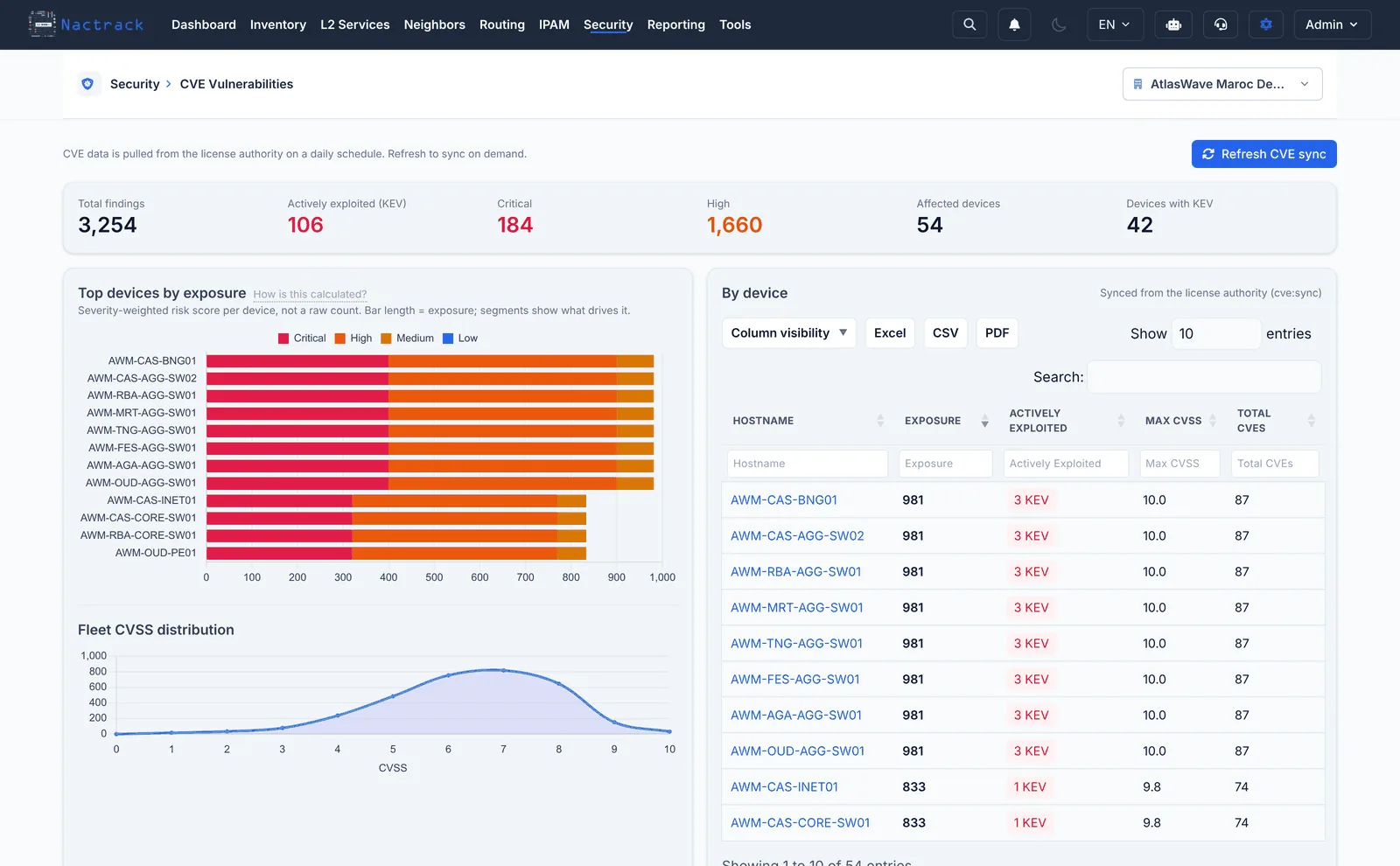
CVE exposure is matched to the exact software version read on each device; SMU patches and configuration conditions are not evaluated, so a finding reads as potentially affected. NacTrack flags end of support too.
Why the exact version changes everything
A vulnerability does not affect a model, it affects specific software versions of a model. Without the exact version you patch what does not need it and miss what matters.
NacTrack knows the version because it read it off the device. Matching against the catalogue becomes mechanical, and the list of affected devices is by name.
- Matched by version, not by model
- Severity, known exploitation, likelihood
- The fixing version named
- Sources: NVD, Cisco PSIRT, CISA KEV, EPSS
- Export for a security committee
From the software read to the named finding
The link that decides everything is the second. Matching on the model instead of the version names devices that are not affected and misses ones that are.
- Devicewhat is running (read-only session)
- Exact versionnot the planned one (command output, not an inventory file)
- Normalised platformone vocabulary (vendor and model, software family)
- Cataloguepublished continuously (affected versions, severity and vector)
- Findingon this device (known exploitation, fixed version)
The catalogue is held by our service, which queries NVD, Cisco PSIRT, the CISA KEV list and EPSS scores, and the appliance synchronises it daily. Matching is on the version: an SMU patch or a configuration condition is not evaluated, so a finding reads as potentially affected. For Huawei, NVD does not reference VRP, and matching does not return findings yet.
End of support, the other missing inventory
- A device past support does not fail on the announcement date. It becomes unrepairable.
- You find out on the day it fails: the part no longer exists, the contract no longer covers it.
- No fix will ship for the next vulnerability that reaches it.
- NacTrack keeps an end-of-sale and end-of-support catalogue per model and matches it against the actual estate.
- The result is a dated list, usable to build a replacement plan and to defend it in budget.
- It is the information most often missing at audit, because producing it requires a current inventory.
Know what your estate is exposed to
The audit matches published CVEs against the versions actually installed on your estate.