
A configuration audit that points to the line at issue
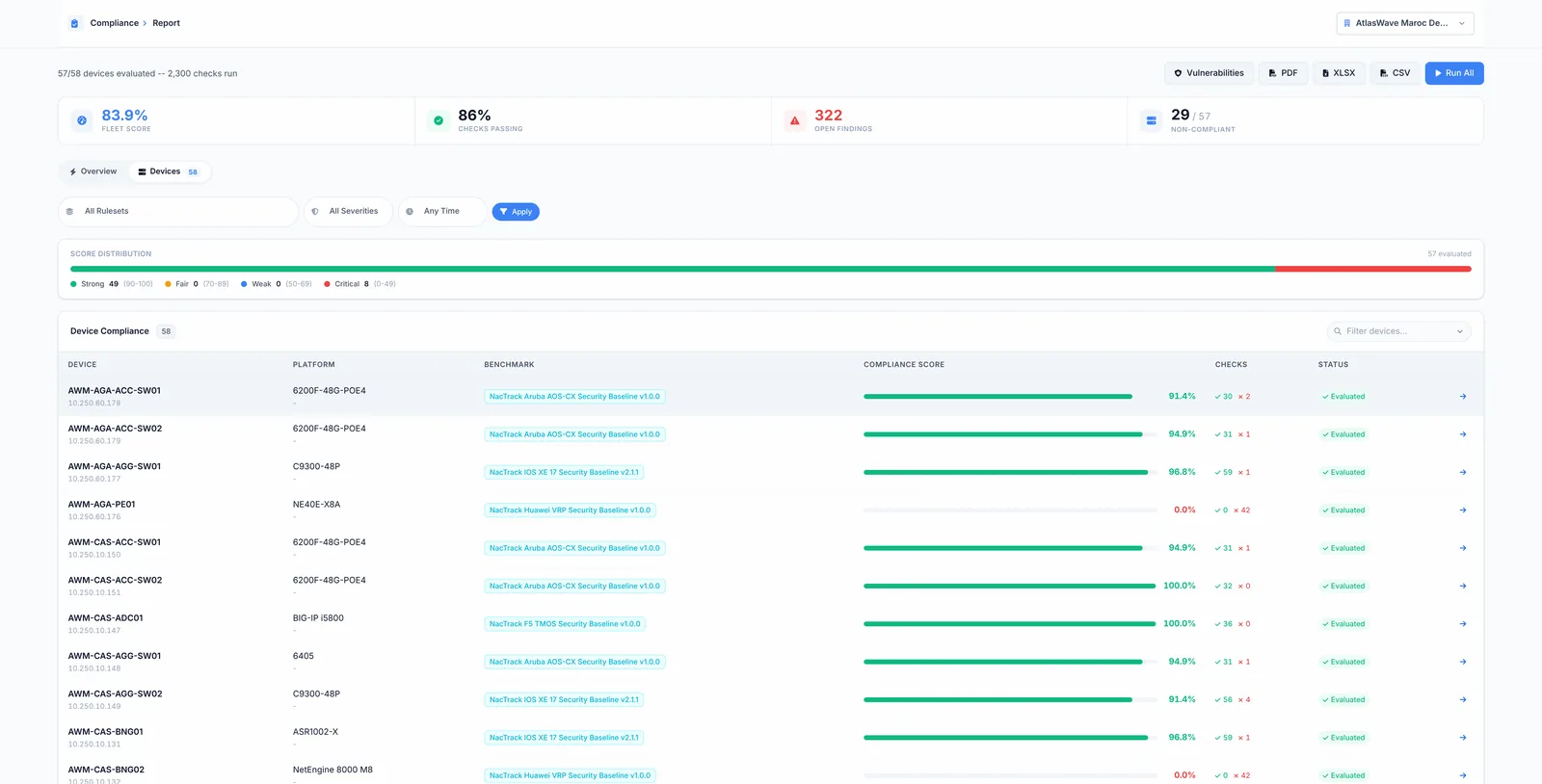
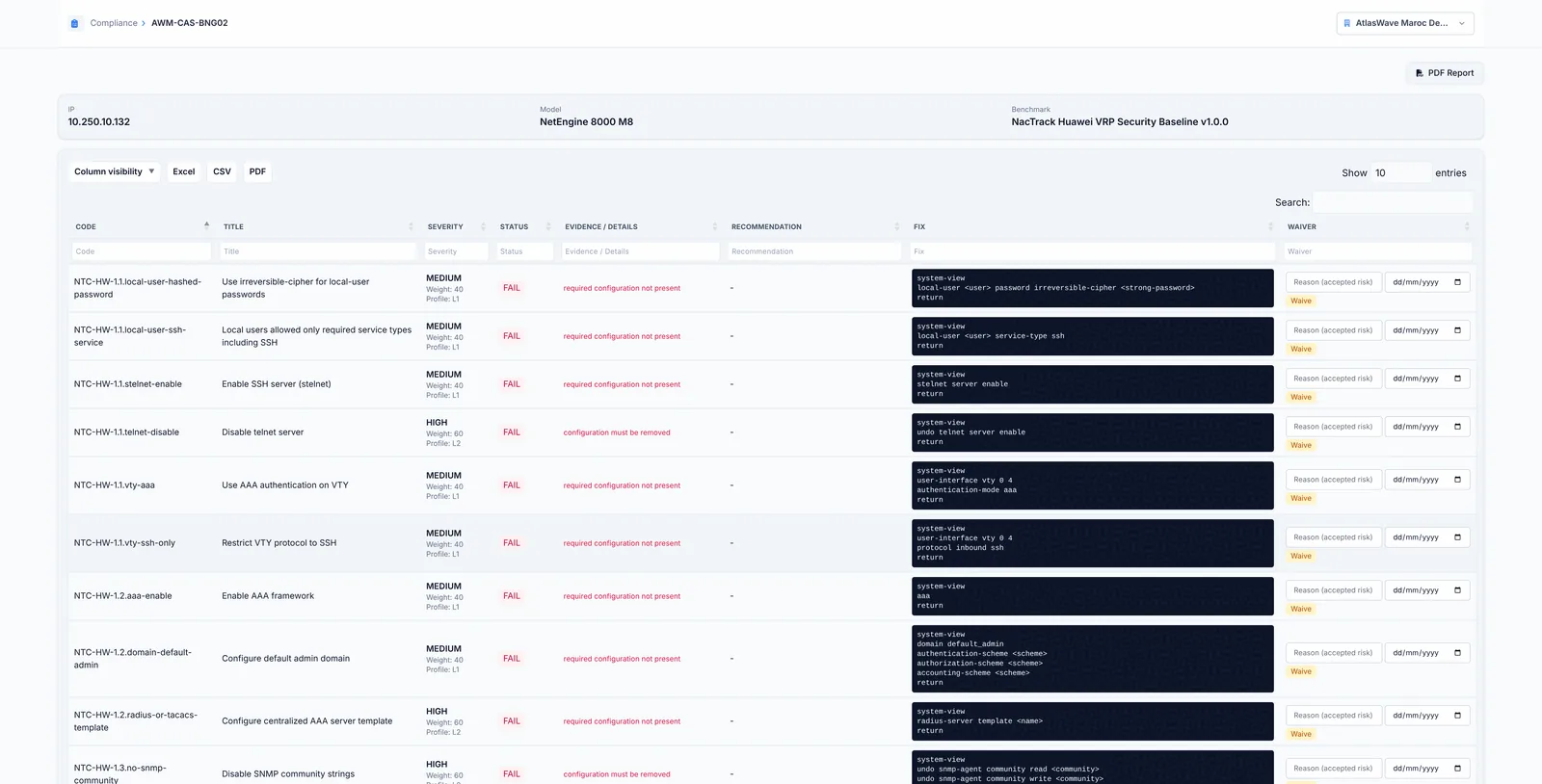
The configuration audit checks each device's real configuration against named rules and returns, for every failure, the extract that triggered it, or the absence of a required line. Each gap comes back with the rule that caught it, the device it sits on and the date it was seen.
A named rule, not an impression
The word weak cannot be measured. An explicit rule can.
- Default SNMP community present. Version 2c allowed. Write community.
- VTY line accepting Telnet. No ACL on administrative access.
- No session timeout set. Password stored in clear in the configuration.
- Every finding carries the rule code, its severity, the configuration extract that triggers it, or the absence of a required line, and the recommended fix.
- The rule sets that ship derive from public hardening baselines and are adapted per platform: a rule written for Cisco and applied as is to VRP measures nothing.
- More than 500 rules, grouped into rule sets per platform and version. A finding can be waived, with its justification; custom rule authoring is not open yet.
- The rule sets evaluate configuration text: they describe what the configuration allows, never what a running session is actually doing.
What the evaluation covers
Management plane
Administrative protocols allowed, separation into a dedicated VRF, ACL applied, banner, session timeout.
Authentication
AAA, TACACS or RADIUS servers, local accounts, password policy, SSH retry limits.
Logging and time
Logging servers, timestamps, NTP, without which no later investigation is possible.
SNMP
Default communities, allowed versions, write access, ACL restriction.
Remote access
Telnet, plain HTTP, SSH versions, what remains open on management interfaces.
What the finding carries
A dated report, per device and per rule, exportable for a committee or a regulator.
Related guides
How to read a device's management access posture
Management exposure is not one setting. Read which services answer, whether they are encrypted, confined to a VRF and centrally authenticated.
How-to guideHow to check whether a device still allows Telnet
Telnet carries passwords in clear text. The devices still answering on port 23 are the ones nobody is watching, which is why they get missed.
How-to guideHow to find devices using default or version 1 and 2c SNMP communities
An SNMP community is a password in clear text, and v1 and v2c have nothing else. Find the devices still carrying public, private or no better.
How-to guideHow to check whether BPDU Guard is enabled on edge ports
BPDU Guard shuts a port the moment a switch appears where only endpoints should be. Check where it is enabled, and where it was forgotten.
How-to guideHow to find out what changed on the network between two collections
Compare two collections and see exactly what moved, on which device and on which line, when nobody is admitting they touched anything.
How-to guideHow to see which ports are configured for 802.1X
Read 802.1X back off the switches themselves: which access ports actually carry it, in which mode, and where MAB is the fallback.
How-to guideHow to audit switch hardening: the checklist
A switch hardening checklist by plane, from Cisco's IOS hardening guide, and how to check it against every collected configuration with the evidence.
Have your estate evaluated
One day, read-only, and a report that belongs to you.