No probe. No agent. No traffic mirror.
NacTrack opens an SSH session on each device, runs read only commands, and closes it. Here is what happens between the session and the answer.
The four stages of a collection
- 1
Connection
SSH with the credentials you provide, read only. Telnet remains possible for devices that offer nothing else, and that is precisely one of the gaps compliance reports.
- 2
Running the platform commands
Each system has its own command set. What IOS shows with one command is read differently on VRP, and differently again on Junos or AOS-CX.
- 3
Parsing and normalisation
Raw output is kept as it came, then parsed into fields comparable across vendors. Keeping the original text matters: a question nobody thought of is often answered from it.
- 4
Correlation
MAC tables, ARP tables, reported neighbours and configurations cross reference each other. Topology, and the answer to any question that spans several devices, comes out of that.
An answer always comes from the last collection, never from the live device. That is a property of the model, and the collection date travels with the data: the views that list collected records carry their timestamp, column by column.
From the device to the answer
The same path, on every collection, for every device on the estate.
Collection
- Network deviceRouters, switches, firewalls, controllers, load balancers. This is the only stage that touches your network, and it reads. Everything after it happens on the NacTrack appliance, on your own infrastructure.
- Read only SSH sessionYour credentials, the same access an operations engineer has. Nothing is written to the device. Telnet remains possible for devices that offer nothing else, and that is precisely one of the gaps compliance reports.
- Per platform command setWhat IOS shows with one command reads differently on VRP or Junos. The full list is published: every command the collector issues, per platform, read out of the collector source rather than typed by hand.
Interpretation
- Per platform parserA dedicated parser per system, not one regular expression for all. One parser per system rather than one shared pattern, so a format change at one vendor stays contained to that vendor.
- Normalised modelThe same fields whatever the vendor. The raw text received is kept exactly as it arrived. Keeping the original text matters: a question nobody thought of is often answered from it.
- Index and historyEvery collection is dated and kept. Two dates compare, and a question asked later still finds an answer. An answer always comes from the last collection, never from the live device, and the collection date travels with the data.
Answer
- Correlation and graphMAC tables, ARP tables, reported neighbours and configurations cross into a single graph. Topology, and the answer to any question that spans several devices, comes out of that crossing.
- What you getSeven families of answer, all from the same collection. All seven come from the same collection. Nothing collected leaves the building.
Only the first stage touches your network, and it reads. Everything after it happens on the NacTrack appliance, on your own infrastructure: nothing collected leaves the building.
What this choice implies
The upside: nothing to deploy on the devices, no impact on the data plane, a first collection of a few minutes per device run in parallel once access exists, and identical behaviour on a heterogeneous and ageing estate.
The pace is not ours to set. A loaded device answers more slowly, and pushing the parallelism is paid for on the device: on some platforms the vty sessions run out or AAA rate limits, and the refusal arrives as an authentication error rather than as a timeout. That is why the number of simultaneous collectors is a per estate setting, taken down to one on sensitive equipment, and why collections are scheduled outside the hours that matter.
The trade off: data is only as fresh as the last collection. NacTrack does not detect a failure the second it happens, and is not meant to. That is your monitoring system's job, and it stays necessary.
- No agent on the devices
- No impact on the data plane
- Read only access is enough
- Works on old hardware
- Real time monitoring stays necessary
Seven steps between what a device says and what you read
The same collection, from left to right. It starts as everything your devices say when asked, and ends as the three or four things somebody has to decide on. Nothing is discarded on the way: the raw text is kept exactly as it arrived.
- Connectwhatever the vendor
- Ask7 protocol families
- Read backkept verbatim
- Parsevendor neutral fields
- Store54 indices, 22 modules
- Correlateone estate, not a list
- Showreport, dashboard, table
Meaning appears only at the seventh step: it is the only place where anything carries a verdict.
And if you want the list, here it is
The figure shows the shape. This is the same thing named: every protocol family read off a device, and every module the licence can open.
02 · Ask, what is read by family
| Discovery and adjacency | CDP · LLDP · ARP · MAC tables |
| Switching | STP · RSTP · MSTP · LACP · VLAN · QinQ |
| Routing | OSPF · OSPFv3 · IS-IS · BGP · EIGRP · VRF · BFD |
| Transport | MPLS · LDP · L2VPN · VPLS · EVPN |
| Gateway redundancy | VRRP · HSRP · GLBP |
| Access control | 802.1X · MAB · TACACS · RADIUS · TrustSec |
| Management plane | SSH · Telnet · SNMP · NTP · DHCP |
05 · Store, the 22 modules a licence opens
Watch it on a real estate
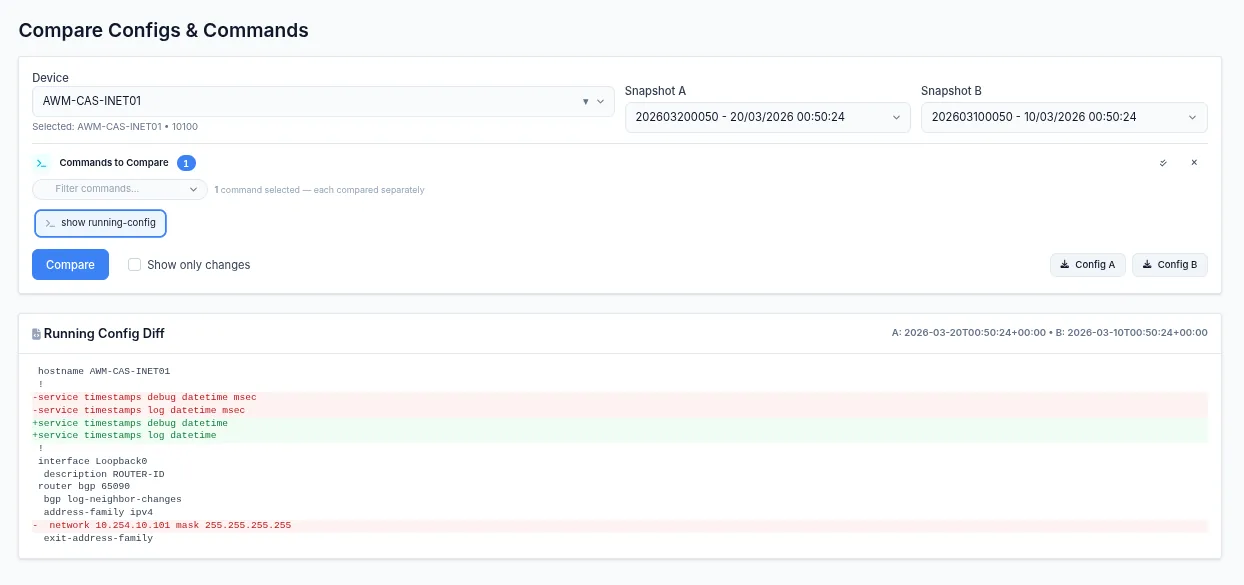
The how to guides show every screen, step by step, with screenshots and video.