
What is no longer supported, and how many you have
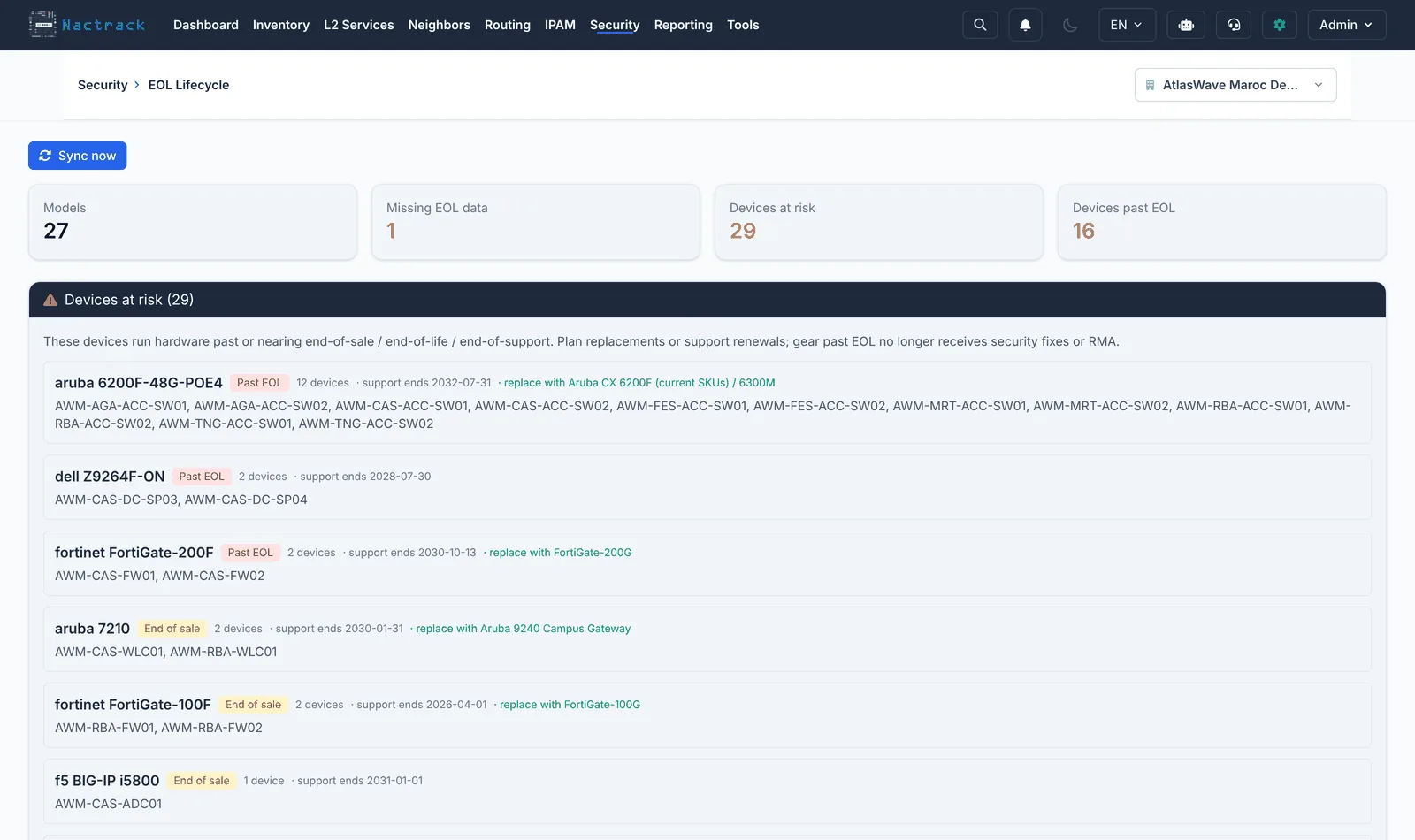
End of support is not a vulnerability, it is a budget date. It arrives on a day known in advance, and it is missed when nobody matches the vendor catalogue against the real estate.
The second is the one nobody publishes
- A model whose end date falls within the next 180 days is flagged at risk, before the date rather than after. The window is configurable.
- The share of the estate with a known lifecycle is a KPI of the report like any other.
- A model absent from the catalogue counts as no data, never as a guess, and it drops out of the coverage percentage.
- Matching is on the vendor and model pair read off the device, not on a family.
From the model read to the dated deadline
The matching is on the vendor and model pair read off the device, not on a product line or a family. An ASR1006 and an ASR1006-X do not share dates.
READ FROM
- Devicewhat is racked
- Vendor and modelexact, not the family
- Lifecycle catalogueheld by the authority
- Status and deadlineper model, with the count
Five states, and one of them is an absence
A hand entered status overrides the computed dates, because a vendor sometimes announces an extension that no published date reflects yet.
| State | What it means | What NacTrack does with it |
|---|---|---|
| Active | No known deadline has passed or been announced. | Counted as covered, kept out of the exposure report. |
| Announced | A date exists, none has passed yet. | Flagged at risk if a date falls inside the window. |
| End of sale | The model is no longer sold, support still runs. | Counted as past end of sale, with the devices affected. |
| End of support | No fixes, no TAC, the date has passed. | Counted as exposed and put at the top of the report. |
| No data | The model is not in the catalogue. | Shown as such, never guessed, and taken out of the coverage figure. |
What the lifecycle report carries
Devices in the fleet
The total everything else is computed against, taken from the inventory rather than from a declaration.
Distinct models
An estate of several hundred devices often comes down to a few dozen models. That is the right grain for a decision.
Past end of support
A count of devices, not of models. Five models can be two hundred machines.
Past end of sale
Still supported but no longer purchasable. This is the state that decides a spares holding.
At risk within the window
What tips over within the next 180 days, so the budget line is raised before the date and not after.
Lifecycle coverage
The share of the estate the data covers. Below 80% the indicator turns to a warning, against us.
This catalogue is curated, not scraped
There is no reliable machine readable vendor feed for end of life dates. The public pages change shape, and automation gets refused.
So the appliance sends your estate's vendor and model pairs to the licence authority and caches what comes back. The catalogue is curated by hand on our side, and a date only enters it once it has been read at the vendor.
The consequence, stated rather than hidden: an end of support date is never inferred from another one. A model with no data stays with no data, and it drops out of the coverage percentage instead of being counted as healthy.
- No vendor feed, a curated catalogue
- A date is never inferred from another
- No data is not counted as healthy
- Matching is on the exact model
How many of your devices are already out of support?
The free audit answers with the number, the model and the date, on your own estate.